One thing that can generally be agreed upon is the International Code Council®’s suite of building codes is always changing. The changes occur on a three-year cycle, and some recent changes included updating the International Energy Conservation Code.®
Beginning with the 2021 IECC, ICC approved a new requirement that affects roofs. Section C401.3, “Thermal envelope certificate,” requires a thermal envelope certificate be provided at the completion of a building project. The certificate is to be permanently posted on a wall in the space where the building’s HVAC equipment is housed, a utility room or other approved location. An approved location is one that is acceptable to the local code official.
If a thermal envelope certificate is posted on an electrical panel, it must not cover or obstruct viewing of the circuit directory labels, the main service disconnect label or any other required electrical labels.
A copy of the thermal envelope certificate also must be included in the construction files for the project and provided to the building owner upon completion of the work.
To comply with IECC, the thermal envelope certificate must include:
- R-values of insulation installed in or on ceilings, roofs, walls, foundations and slabs, basement walls, crawl space walls, and floors and ducts outside conditioned spaces
- U-factors and solar heat gain coefficients of fenestrations (doors, windows and skylights)
- Results from building envelope air leakage testing performed on the building
If there is more than one value for any building envelope component, the thermal envelope certificate must provide an area weighted average where available. If an area weighted average cannot be provided, the value for each individual area greater than 10% of the total must be listed.
For example, if a building has two or more distinct roof areas with different total R-values of insulation, the area weighted average R-value reported on the thermal envelope certificate would be Roof Area 1 multiplied by R-value 1 plus Roof Area 2 multiplied by R-value 2 all divided by the sum of Roof Area 1 plus Roof Area 2: [((RA1 x R-value1)+(RA2 x R-value2)+ …)÷(RA1 + RA2 + …)].
If the area weighted average cannot be calculated, each individual roof area greater than 10% of the total roof area must be listed on the thermal envelope certificate.
The rationale for requiring the posting of a thermal envelope certificate for a new building is to avoid losing the basicinformation contained on the certificate as a building ages and ownership or building management changes. The required information on the certificate also could be used for calculating replacement HVAC equipment.
A similar requirement has existed in IECC’s residential requirements since 2006.
Currently, only newly constructed buildings following the 2021 and 2024 editions of IECC require the posting of a thermal envelope certificate
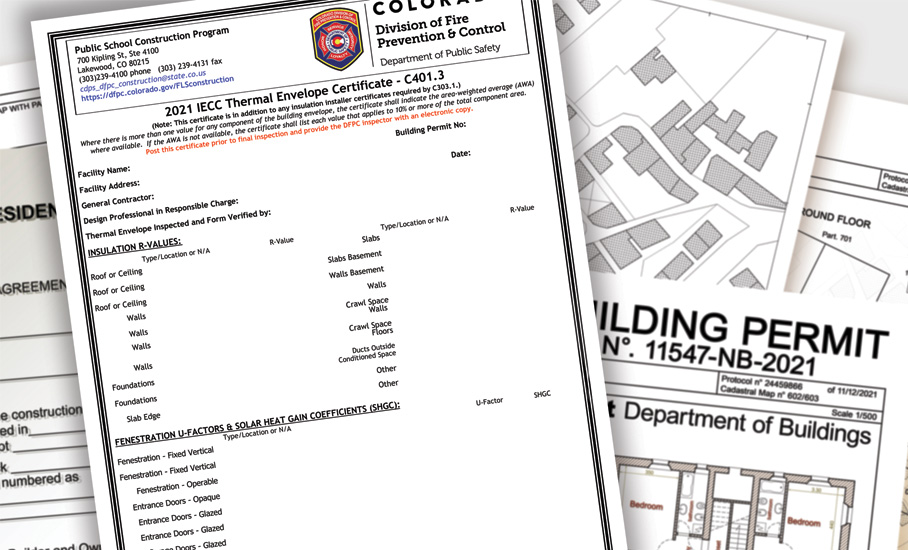
IECC does not provide a standard template for thermal envelope certificates. However, local jurisdictions, such as Colorado, may have a suggested template.
Currently, only newly constructed buildings following the 2021 and 2024 editions of IECC require the posting of a thermal envelope certificate. The roofing-specific portion of the thermal envelope certificate is not currently required to be added or updated for reroofing projects.
The 2027 edition of IECC is being reviewed and updated. A proposal, C503.2.8, “Building thermal envelope certificate alterations,” was introduced and has been preliminarily approved. It will require the building thermal envelope certificate to be updated to reflect a building’s altered portion.
IECC’s 2024 edition modified the definition of a roof replacement to “an alteration that includes the removal of all existing layers of roof assembly materials down to the roof deck and the installation of replacement materials above the existing roof deck.” The key word in the revised definition is “alteration.” With IECC 2027, this means a building thermal envelope certificate will be required to be posted and provided to the owner for a roof placement. In addition, the new proposed language will require a building without an exist-ing building thermal envelope certificate to comply only with the requirements for the area of work altered.
In either case, for all buildings only a roof assembly’s new R-value would be required to be updated following a roof replacement beginning with IECC 2027.
Additional roof assembly energy code requirements can be found at codes.iccsafe.org.

Glen Clapper, AIA, LEED, AP
Director of technical services
NRCA