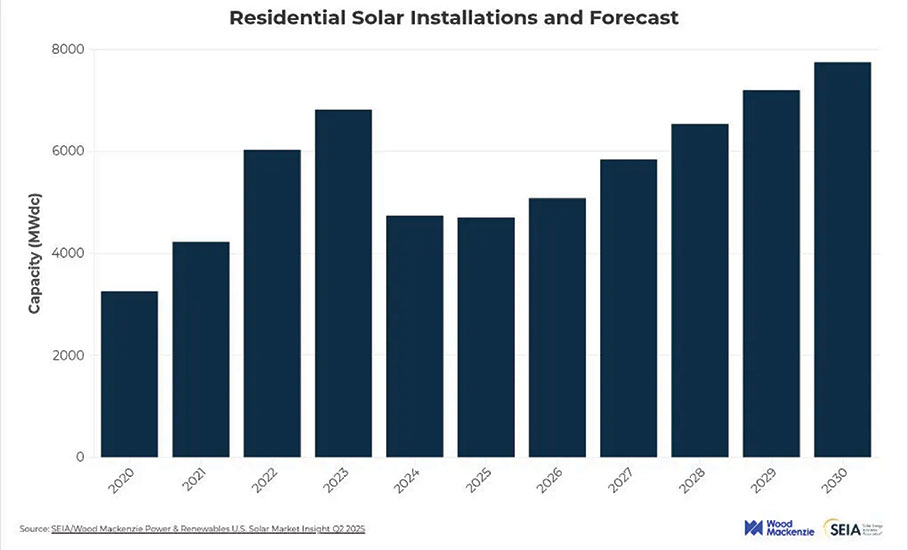
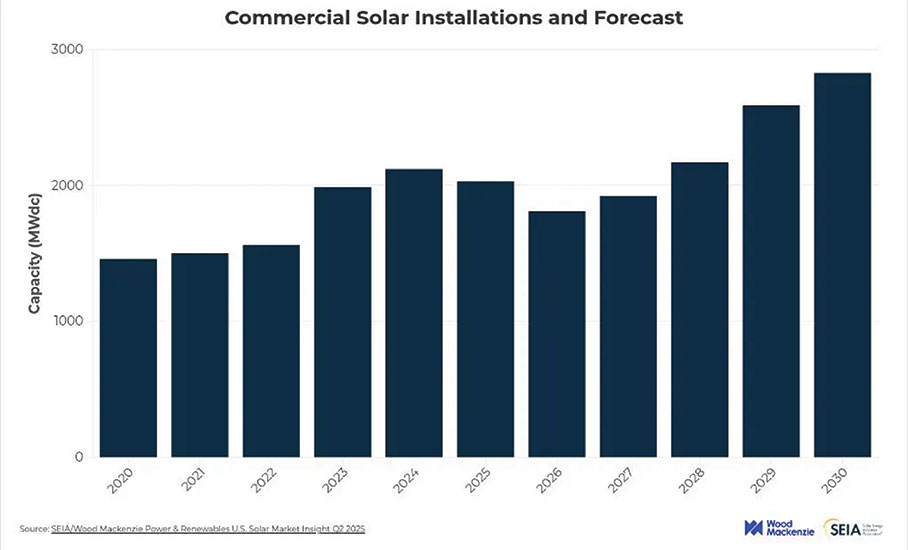
The solar industry in the U.S. has seen significant growth in recent years. It has become increasingly common to see photovoltaic systems on the roofs of homes and businesses. According to the Solar Energy Industries Association, all PV systems accounted for 54% of all new electricity-generating capacity added to the U.S. grid in 2025 (see figures below).
Building owners are taking advantage of available rooftop space, and homebuyers are increasingly seeking homes that already have solar systems installed on their roofs, according to the Department of Energy. With growing demand for PV roof systems, knowing the ins and outs of the current PV marketplace can help your business gain a competitive advantage.
The financial aspect
The 30% federal residential clean energy credit expired Dec. 31, 2025, but the following states continue to participate in solar tax breaks: Arizona, California, Colorado, Connecticut, Florida, Illinois, Maryland, Massachusetts, Minnesota, New York, New Jersey, Ohio, Texas and Virginia.
Although the residential tax credit no longer is available, the month-by-month costs for solar versus electric may allow a homeowner to pay off the PV installation within 10 years, according to EcoFlow, a provider of eco-friendly energy solutions. This return on investment can be a plus for homeowners who plan to remain in their homes long term.
Many buyers will finance their PV installations, according to Palmetto Solar, a residential solar energy provider, through a home equity loan, bank loan, credit union or finance company. Roofing contractors who work with a credit company can simplify this process for customers by having all the information for their installations in one place. When a roofing contractor, homeowner, and credit or insurance company work together, there is less of an opportunity for miscommunication and confusion between parties.
The Department of Treasury advises homeowners to “shop around” for deals on financing PV installations as services vary in pricing and interest rates depending on the seller.
Some solar systems or PV panels are insurable under a homeowner’s policy. Most major insurance companies will include solar panels with coverage as they are considered an attachment to the home. If the panels are damaged from weather events such as tornadoes or high winds, the solar panels or shingles may be insured and protected.
With more homeowners installing solar each year, consider the effect solar could have on your company
Pros and cons
There are pros and cons to having a PV system installed on a roof, including pricing, installation, aesthetic and more.
Benefits
- Solar energy is abundant. Because solar relies on sunlight to generate electricity, the amount of energy that can be produced is limitless. With 173,000 terawatts of solar energy striking Earth continuously, it is the most abundant energy resource. That is more than 10,000 times the world’s total energy use, according to the Indiana Office of Energy Development. Additionally, DOE says less than two hours of sunlight generates enough power to meet the world’s energy consumption for an entire year.
- Solar is a renewable energy source. According to SEIA, solar power is the cleanest renewable energy source available. It is powered by sunlight, which will never run out, and differs from oil and gas because those cannot be naturally replenished in any reasonable time scale. According to Palmetto, solar panels also are recyclable, which extends their renewable timeline as new panels can be recreated repeatedly rather than turning into wasted material.
- The solar industry is growing. According to the SEIA, there are more than 279 gigawatts of total solar systems installed in the U.S., which is enough to power 47 million homes. During the past decade, the U.S. solar market has increased at an average rate of 25% each year.
- Solar increases home value. In a 2019 study conducted by online real estate platform Zillow, homes with PV installations tend to sell for about 4.1% more than homes without solar—and sell 20% faster. Also according to Zillow, 80% of homebuyers say energy efficiency is a priority when choosing a home. In a 2025 study conducted by Solar Insure, a solar insurance company for commercial and residential installations, homes with solar panels sell for 5-10% more than homes without them.
Drawbacks
- Solar energy relies on weather. Although solar energy can be generated on a cloudy day, some level of daylight is required to extract the sun’s energy, and the amount of energy that can be produced can vary depending on the amount and quality of direct sunlight. Panel technology as well as the size, number and locations of the panels makes a difference. In addition, tornadoes and high winds can destroy complete systems, resulting in a need for maintenance.
- High upfront costs. Although having solar panels is cheaper year-to-year, according to Ecoflow, the upfront installation cost can be high. Installing a PV system on an average home in the U.S. in 2026 has an expected value of around $25,000-$30,000 before incentives. However, EcoFlow estimates most systems pay for themselves in six to 10 years by saving $80 to $250 or more per month. Paying off larger systems may take up to 12 years.
- Need for battery storage. Storing excess electricity for use during a power outage is one of the main appeals to having solar panels. Although the batteries are useful, they are an extra expense, and some homeowners find them to be an eyesore. The batteries can cost between $12,000-$22,000, according to the Department of Energy. However, many manufacturers offer a “solar plus storage” system that serves as a package deal on panels and a battery for less than buying the two separately. These packages cost between $25,000-$35,000 depending on various factors such as size of the battery and amount of roof panels in use, as well as the manufacturer.
Panels or shingles
When considering solar for their homes, most homeowners think of solar panels, the most popular system currently in use. Solar panels are installed on top of an existing roof (or on the ground) and require an updated roof system inspection to ensure the roof will be able to hold the weight of the panels. This requires the services of a professional roofing contractor to ensure a watertight installation.
A lesser-known option is solar shingles. Solar shingles are installed as part of a roof system rather than on top of an existing roof system. They provide familiar roof aesthetics while functioning as a building material and an energy-generating device. They are designed to integrate with PV materials and can be sized to meet a household’s energy demand.
Solar shingles cost between $20,000-$100,000 depending on labor and installation variety. This makes solar shingles more expensive than solar panels, but if a homeowner needs to replace a roof before installing solar panels, solar shingles may be more cost-efficient over time. Although still considered a niche product, solar shingles can be a viable option for eco-friendly roofing.
Some solar manufacturers such as CertainTeed, Malvern, Pa.; GAF, Parsippany, N.J.; and Tesla, Austin, Texas, currently produce solar shingles.
Commercial efforts
For commercial buildings, installing solar may be viewed as a low-risk investment. According to Paradise Energy Solutions, a commercial and residential solar energy installer and maintenance company, when installing PV panels on a commercial roof, the company is banking on electricity prices rising, equipment lasting and the sun continuing to shine. With a potential lifespan of 25 to 30 years, solar energy can be a great investment long term.
If a business is planning on moving locations, solar is not a great option because of the upfront costs. However, if a company is planning on staying put for the near future, the investment can be worth it.
List of solar training programs through the Department of Energy Solar Energy Technologies Office
Code compliance
Building codes for PV applications are complex. Because building-integrated PV panel systems have dual functionality as roof coverings and electricity-generating products, confusion and disputes can arise about who conducts the inspections, installations and maintenance.
“Code compliance for rooftop PV applications is a relatively complex undertaking,” says Mark Graham, NRCA’s vice president of technical services. “Not only is compliance with NEC 70: National Electrical Code needed, but also portions of the applicable fire code and applicable International Building Code or International Residential Code are needed.”
In addition, there are several factors building owners, designers, installers and utility companies should consider to ensure proper installation and code compliance.
- Rooftop-mounted PV systems should always involve a professional roofing contractor and may also need to involve a licensed electrician to oversee the proper installation of the electrical components.
- Many jurisdictions have requirements for licensed electricians to perform inspections.
- Several states and local jurisdictions have enacted special licensing requirements for PV system installers.
For highlights from the International Building Code® and International Residential Code,® see “Code specifications.”
Consider training in solar
Providing your workers with solar design installation and training to further their expertise will help expand your company’s installation capabilities. According to the DOE: “Deploying safe, reliable solar energy systems requires a skilled workforce that is properly trained to design and install these technologies. Additionally, maintaining these systems across decades of expected operation requires experienced technicians who can identify and address any safety or performance issues.”
Allowing workers to develop new skills in roofing can ensure they are constantly learning, growing and maintaining a passion for the field, as well as enabling them to work on new projects and expand your company’s offerings to customers.
DOE’s Solar Energy Technologies Office has a variety of programs that have improved access to technical careers in solar design and installation.
Code specifications
The International Building Code® and International Residential Code® contain specific requirements for building-integrated photovoltaic roof panels and shingles. Following are some highlights:
- IBC 2024 Section 1505.9 states: “Rooftop-mounted photovoltaic panel systems shall be tested, listed and identified with a fire classification accordance with UL 2703.”
- IBC 2024 Section 1505.9 also states: “Rooftop-mounted PV systems and elevated PV support structures installed on top of buildings shall be assigned to the same risk category as the risk category of the building on which they are mounted.”
- IBC Section 1507.16.6 states: “Material standards require listing and labeling in accordance with UL 7103, ‘Outline of Investigation for Building-Integrated Photovoltaic Roof Coverings.’”
- IRC 2024 Section R329 states: “PV panels and modules must be labeled in accordance with UL 1703, or both UL 61730-1 and UL 61730-2”; “Structural requirements provide for the minimum roof loads and wind loads for rooftop-mounted PV system”; and “PV panel systems must have the same fire classifications as the roof assembly.”
Expanding your offerings
A PV or roof system designed to generate power can be the eco-conscious solution your customers are seeking. Offering solar installations is a great way to ensure your company meets demand and stays with rising trends. With more homeowners installing solar each year, consider the effect solar could have on your company.
The next time a homeowner or building owner asks about roofing options, invite them to explore PV systems as a viable option.

JOSEPHINE BURNHAM
Editorial Assistant for
Professional Roofing