
My wife and I recently started touring colleges with our oldest child and will likely be doing it “All Summer Long.” It’s been quite eye-opening and much more of a production since I went to school decades ago. “We didn’t have no internet; but man, I never will forget ….” It’s much more complicated, intense, competitive and costly than back then!
Our soon-to-be 18-year-old told us he’s looking at pulling a Kid Rock “Cowboy,” packing up his game and heading out West, but we are trying to show him different options and expand his aperture. The broadening of horizons doesn’t just include regions of the country but entire career trajectories; the trades being a sizable part of the conversation.
Sitting through a few rounds of colleges pitching themselves has been a bit depressing and alarming. Some explicitly focus on preparing students for a future by touting their job placement rates, average salaries post-graduation and how their graduates are poised to (hopefully) succeed at what they are passionate about.
Other schools seem to emphasize the enlightening or growing experience a student will have but not necessarily what comes next. As a self-described heartless fiscal conservative that had to pay my own way through college, I admittedly relate more to the first pitch versus the latter.
I couldn’t help but think several schools weren’t telling the complete “Picture” “where everyone knows but they won’t tell. But their half-hearted smiles tell me something just ain’t right.” The headlines and narratives have been brutal for new college grads in recent years, yet the schools don’t seem to acknowledge it—and society is only beginning to.
We are educating hundreds of thousands of young people for careers that don’t exist or are increasingly declining. We are setting them up to have a wonderful four years but then a miserable four-plus decades afterward, often loaded with debt they can’t afford to pay or that forces them to delay moving on with life.
Recent data from the Department of Education reports nearly 25% of the 43 million Americans with federal student loans are significantly behind in their loan payments. And at the end of 2025, 7.7 million of them had defaulted on $181 billion in loans. The delinquency and default rate was the highest it’s been since the government began keeping track. This is not stewardship or guidance. It is exploitation. “Only God Knows Why” adults explicitly tasked to help minors would push them into this financial and life path. Adulting is hard, but it’s even more difficult when you are starting in the hole.
This isn’t “set up shop at the top of Four Seasons … with the top let back and the sunshine shining” and “singing Sweet Home Alabama all summer long.” These kids run into the buzzsaw of reality moments after their caps and gowns are back in the closet.
I spoke with some younger graduates recently, and they talked about how they sent out hundreds of resumes and looked for more than a year before finding work in their fields. Some still haven’t.
I also spoke to a parent who works for a roofing company. Her son graduated more than a year ago and is still unemployed. I asked whether he had considered working for her company and she said he was still hoping to find something in computer science. “He feels like number one, but he’s last in line.”
I recently rewatched a John Mulaney comedy special where he spent a few minutes succinctly summing up his college ROI and the issue at hand. A portion of it went: “What is college? … Because I went to college, and I have no idea what it was. … College was like a four-year game show … but instead of winning money you lose $120,000. By the way, I agreed to give them $120,000 but I was 17 years old with no attorney present … that’s illegal! They tricked me! They pulled me out of high school … and two guys in clip-on ties are like ‘Come on, son, do the right thing, sign here and you’ll be in English major.’ I was like, OK. … Yes, you heard me … an English major! I paid $120,000—how dare you clap for the worst financial decision I ever made in my life—I paid $120,000 for someone to tell me to go read Jane Austin … and then I didn’t!”
The college ivory tower is getting a bit tarnished. Let’s blow the roof off it.
Some may say “it’s all good, and it’s all in fun” and those four years are special and wonderful. They are not entirely wrong, but then kids are potentially stuck back in parents’ basements with mountains of debt saying: “Somehow I know there’s more to life than this. You [are supposed to] get what you put in and people get what they deserve. Still I ain’t seen mine. I’ve been giving, just ain’t been getting … [I’m still looking for the payback].”
As an industry, we can and need to step into this growing void for the good of our industry and, ultimately, the youth coming into this industry. I spoke about this during the 2026 International Roofing Expo® and repeat the refrain whenever I’m able. There are able-bodied workforce prospects out there, and we need to be going after them. It won’t solve all the industry’s workforce issues (immigration reform is still necessary), but it can address some. As these young adults increasingly look for alternatives to ivy-covered college walls and student loans larger than many mortgages, shame on us if we don’t tell them our story.
You all make sales pitches to customers daily. You actively tell people why they should choose you for your service or product. Similarly, the industry also must actively tell people why they should choose us, choose you, for their careers.
Folks are willing to listen. Lumina Foundation and Gallup recently partnered on research that stated 26% of vocational students transferred to a vocational school because of their concerns with AI and job prospects in the future. In a separate national survey, Gallup found only 27% of college graduates stated now is a good time to find a job, the lowest since coming out of the Great Recession.
Parents, counselors, teachers and society are waking up to alternative ways to achieve the American Dream. Let’s help them along. NRCA is doing it bro-adly and has resources to help you (see careersinroofing.com), but it takes contractors on the ground to close the deal.
In 1964, Manfred Man sang, “Do wah diddy diddy dum diddy do.”
In 1998, Kid Rock sang, “Bawitdaba, da-bang, da-bang, diggy.” Both catchy. Both fun. But like college today, neither probably make any sense to most. But if it’s the only song playing, it’s the only song kids are hearing. Let’s help them turn the dial.
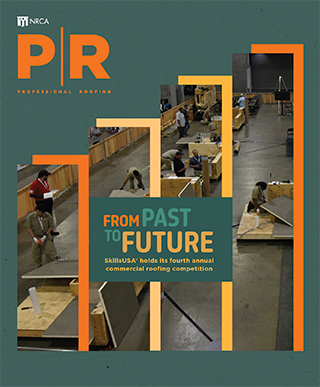
SkillsUSA,® a competition among students in high school or trade schools, just wrapped up its latest national championship in roofing. There were about 15,000 attendees in Atlanta for the national skills competition. The students, teachers and career counselors involved with SkillsUSA are wanting to talk with you. They are looking for contractors willing to recruit young people and give them careers.
If you’d like to learn more, email Amy Staska, NRCA’s vice president of workforce development, at astaska@nrca.net and tell her you are willing to work a bit to find workers versus waiting, hoping or pray-ing for them to spontaneously knock on your door. The college ivory tower is getting a bit tarnished. Let’s blow the roof off it.

MCKAY DANIELS
CEO
NRCA