Construction spending fell in January

According to the Associated Builders and Contractors, nonresidential construction spending decreased 0.3% in January and is up 1% compared with January 2025.
In public construction, spending was up 0.6% in January and is up 4.5% year to date. Private nonresidential spending decreased 0.4% in January and is down 3% year to date. Spending was down for the month in nine of the 16 nonresidential subcategories.
“Private nonresidential construction spending contracted for the fourth consecutive month in January and is now down 8% from the December 2023 all-time high,” says ABC Chief Economist Anirban Basu. “While harsh winter weather likely bears some blame, the major issue is the ongoing decline in computer/electronic manufacturing construction. With CHIPS Act-incentivized megaprojects wrapping up, spending in that subcategory is down nearly 40% over the past 18 months.
“With the exception of data centers, which saw another 2% jump in spending during January, there are few sources of momentum to offset the precipitous decline in manufacturing construction activity,” Basu continues. “While ABC’s Construction Backlog Indicator rebounded slightly in February, rising 0.1 months from January’s four-year low, it may be a difficult first half of 2026 for many contractors.”
NRCA elects new officers and directors
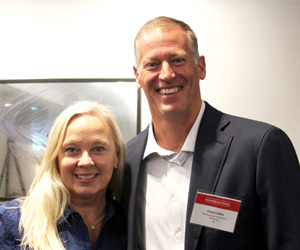
NRCA elected its 2026-2027 slate of officers and directors.
Chad Collins, executive vice president of Roofing Corp of America, Atlanta, was elected chairman of the board. Sherri Miles, vice president of J.D. Miles & Sons Inc., Chesapeake, Va., and president of Miles Roofing Inc., Chesapeake, was elected chairman of the board-elect (see “Visionary playbook”).
Michelle Boykin, branch manager at Weather Shield Roofing Systems, Pensacola, Fla.; Scott Kawulok, vice president of B&M Roofing of Colorado Inc., Frederick; and Lynn Price, president of Dryspace, Cedar Rapids, Iowa, were elected vice chairmen for two-year terms. Jean-Paul Grivas, vice president of Ray Nolan Roofing Co. Inc., Louisville, Ky.; Paige Harvill, corporate projects manager at Nations Roof LLC, Mobile, Ala.; and Diana Petersen, director of administration at Red Point Roofing LP, Orange, Calif., were elected as vice chairmen for a one-year term.
Additionally, the following were elected as new NRCA directors:
- Greg Arnold, president of Nations Roof, West Haven, Conn.
- Matt Atkinson, general manager of Bone Dry Roofing, North Charleston, S.C.
- Alexandra Chacon, division manager at Construction Link Outsourcing, San Jose, Costa Rica
- Eric Dosch, vice president of Schwickert’s Tecta America LLC, Mankato, Minn.
- Heidi Ellsworth, president and CEO of The Coffee Shops, Sister. Ore.
- Bryson Galloway, vice president and general manager of Barr Roofing Co., Abilene, Texas
- David Hesse, executive vice president of Kalkreuth Roofing & Sheet Metal, Frederick, Md.
- Anthony Kahny, president and COO of Deer Park Roofing LLC., Cincinnati
- Josh Kelly, senior vice president of business development at OMG Inc., Agawam, Mass.
- Gregory Malcolm, owner of IronShore Contracting LLC, Baltimore
- Jonathan Reader, manager of R&B Roofing LLC, Garland, Texas
- Tim Stephens, vice president of operations at Architectural Sheet Metal Inc., Orlando, Fla.
Negative feedback can make or break a workplace

Negative feedback can be a difficult thing to give out but is ultimately helpful when given constructively. However, if that negative feedback is given in a destructive manner, it can have lasting emotional effects on employees, hurting performance rather than improving it.
A Harvard Business Review survey showed 81% of full-time U.S. employees have experienced destructive feedback, and 78% of those employees described feedback so hurtful they could recall it vividly years later.
Destructive criticism often presents itself as negative feedback with no corrective instructions; false or unfair criticism; dismissiveness or contempt; character attacks; or public shaming. Receiving strong negative feedback can make people question their abilities; cause them to leave the company; destroy their view of the company or its culture; and ultimately hurt their career growth.
Harvard Business Review shared the following practices for preventing deconstructive criticism and promoting constructive feedback.
- Set clear guardrails for criticism. Leaders must explicitly state criticism should not humiliate, shame, punish or attack someone’s character. This reduces ambiguity and sets expectations that feedback should be delivered in a constructive way. Train leaders to identify a specific behavior, explain why it matters and outline clear steps.
- Slow down the moment of feedback. Many destructive comments are made spontaneously and during moments of frustration. Leaders should pause and ask themselves whether they are reacting to a person or responding to a behavior, and whether the employee will leave the discussion with clear next steps to improve. Postpone the conversation if emotions are high.
- Repair quickly when feedback goes wrong. Feedback does not always land as intended. When criticism is destructive, it is important to acknowledge the employee’s value, clarify intent and rebuild psychological trust.
- Guard against bias disguised as feedback. Bias can lead to destructive criticism that targets certain employees or groups. Leaders should periodically review which employees receive critical feedback from them, the frequency of the feedback and the tone used to convey it. Then, leaders should look for disparities across the feedback they give their teams and address them. Focus on work rather than personal impressions and pull from observable behaviors, results and shared performance standards.
QXO becomes second-largest distributor in North America

In April, QXO, Herndon, Va., announcedit has entered into a definitive agreement to acquire TopBuild Corp., Daytona Beach, Fla., for about $17 billion. The transaction is expected to happen immediately and will significantly expand QXO’s scale and capabilities across the building products value chain.
TopBuild is the largest distributor and installer of insulation and related building products in North America. The combination will bring together QXO’s offerings in roofing, waterproofing, lumber-related building materials and associated products with TopBuild’s insulation capabilities.
This acquisition will allow QXO to become North America’s second-largest publicly traded building products distributor with more than $18 billion of combined company revenue and more than $2 billion of combined company adjusted EBITDA.
Upon completion of the transaction, QXO will operate as an addressable market of more than $300 million and hold leadership positions in key building product verticals in North America.
Following the acquisition of TopBuild, QXO will have about 28,000 employees; 1,150 locations across 50 U.S. states and seven Canadian provinces; and a fleet size of more than 10,000 vehicles.